

Four most important processes of biomass briquette production line
Biomass briquette production line is an important technical means to convert biomass resources such as agricultural and forestry wastes into clean energy. In the production process, there are four key processes that directly determine the quality and efficiency of final products, namely crushing, drying, briquette making and carbonization.
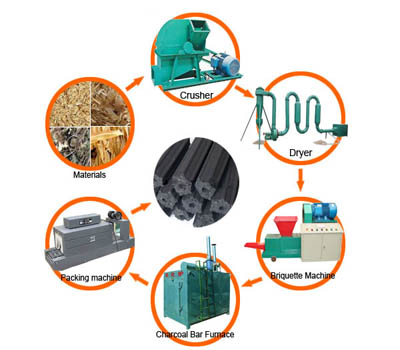
The first is the crushing process. In the natural state, biomass raw materials such as straw, sawdust and rice husk are large in volume and irregular in shape, which is not conducive to subsequent processing. Therefore, raw materials must be processed into a state of fine particles and uniform particle size by crushing equipment. This process not only improves the density of raw materials, but also lays the foundation for the following drying and briquette making processes.
Next is the drying process. The moisture content of biomass raw materials is usually high, and high moisture content will affect the forming effect of briquette machine. Therefore, raw materials need to be dried to control their moisture content within a reasonable range (generally 8%-12%). This link puts forward higher requirements for energy consumption and equipment efficiency, so it is particularly important to choose efficient and energy-saving drying equipment.
The third process is briquette making. The raw materials after crushing and drying are sent to a biomass briquette machine, and finally biomass briquettes with high density and regular shape are formed through high-temperature and high-pressure extrusion molding. This process requires precise control of temperature and pressure to ensure the stability and strength of the finished product. At the same time, the mold design and durability of the briquette making machine also directly affect the production efficiency and product quality.
The last step is carbonization. Biomass briquettes are treated at high temperature in the carbonizing furnace to remove volatiles and generate fixed carbon, thus increasing their combustion value. This link not only determines the performance of final products, but also affects their competitiveness in the market. During carbonization, temperature and time should be strictly controlled to avoid over-burning or insufficient carbonization of products.
In a word, crushing, drying, briquette making and carbonization are four indispensable links in the biomass briquette making production line, and each step plays a vital role in the quality of final products. Optimizing each process can not only improve production efficiency, but also promote the sustainable development of biomass energy industry.