

Process of making charcoal briquettes
The process of making charcoal briquettes typically involves the following steps: raw material crushing, drying, shaping, carbonization, cooling, and packaging. Here is a brief description of each step:
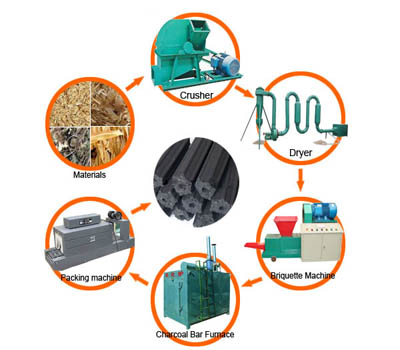
1. Raw material crushing: The first step in making charcoal briquettes is crushing the raw materials. Commonly used materials include sawdust, bamboo shavings, rice husks, and coconut shells. These materials need to be processed into smaller particles using a crusher for subsequent processing.
2. Drying: Crushed raw materials usually contain a certain amount of moisture; excessive moisture will affect the shaping effect. Therefore, drying equipment is needed to reduce the moisture content of the raw materials to a suitable level (generally between 10% and 15%).
3. Shaping: The dried raw materials are fed into a wood briquette machine or other biomass briquetting machine, where they are compressed under high pressure. This process presses the raw materials into briquettes of a fixed shape, such as cylindrical or square. This step requires ensuring that the pressure and temperature of the briquette machine are appropriate to guarantee the density and quality of the briquette.
4. Carbonization
The formed charcoal briquettes are then fed into a carbonizing furnace for carbonization. In a high-temperature, oxygen-free environment, the organic matter in the charcoal briquettes decomposes, producing high-quality charcoal. The carbonization process requires strict control of temperature and time to ensure the charcoal’s combustion performance and environmental characteristics.
5. Cooling
The carbonized charcoal briquettes are still quite hot and need to be cooled. Cooling can be done naturally or using cooling equipment. Cooled charcoal briquettes are harder and less prone to breakage.
6. Packaging
The final step is to package the cooled charcoal briquettes. Depending on market demand, they can be packaged in cardboard boxes, woven bags, or plastic bags for easy storage and transportation.
By following the steps above, the charcoal briquettes produced are not only highly efficient in combustion but also environmentally friendly and smokeless, making them widely applicable in areas such as barbecues and heating.